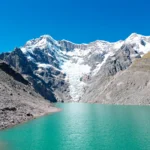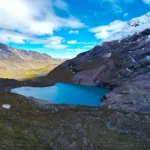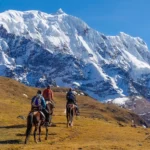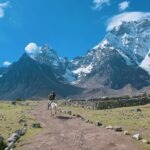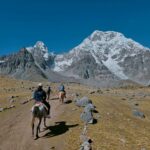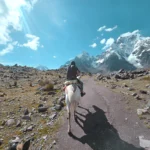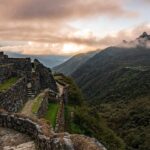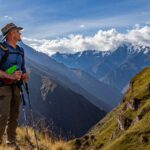



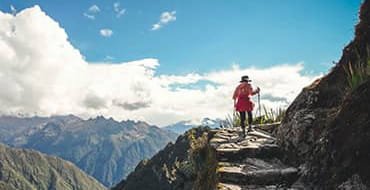
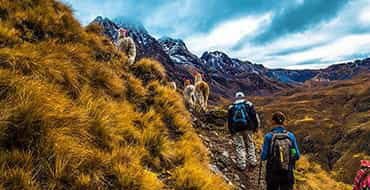
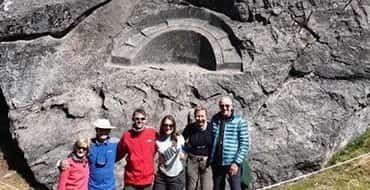
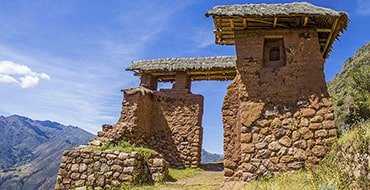

The Ausangate Trek is one of the most breathtaking hiking adventures in Peru and all of South America. Unlike the Inca Trail or the Salkantay Trek, this route takes you deep into the heart of the Peruvian Andes, where snow-capped mountains, turquoise glacial lakes, colorful valleys, and traditional Quechua communities create an unforgettable experience.
Many travelers wonder whether the Ausangate Trek is too difficult for beginners. The good news is that yes, beginners can complete it, provided they prepare properly, acclimatize to the altitude, and take the trek at a comfortable pace.
This guide will explain everything you need to know before starting your adventure, including the difficulty level, altitude, camping conditions, what to pack, acclimatization tips, and a complete 5-day itinerary.
What Makes the Ausangate Trek Special?
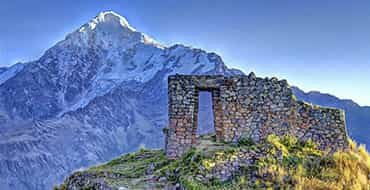
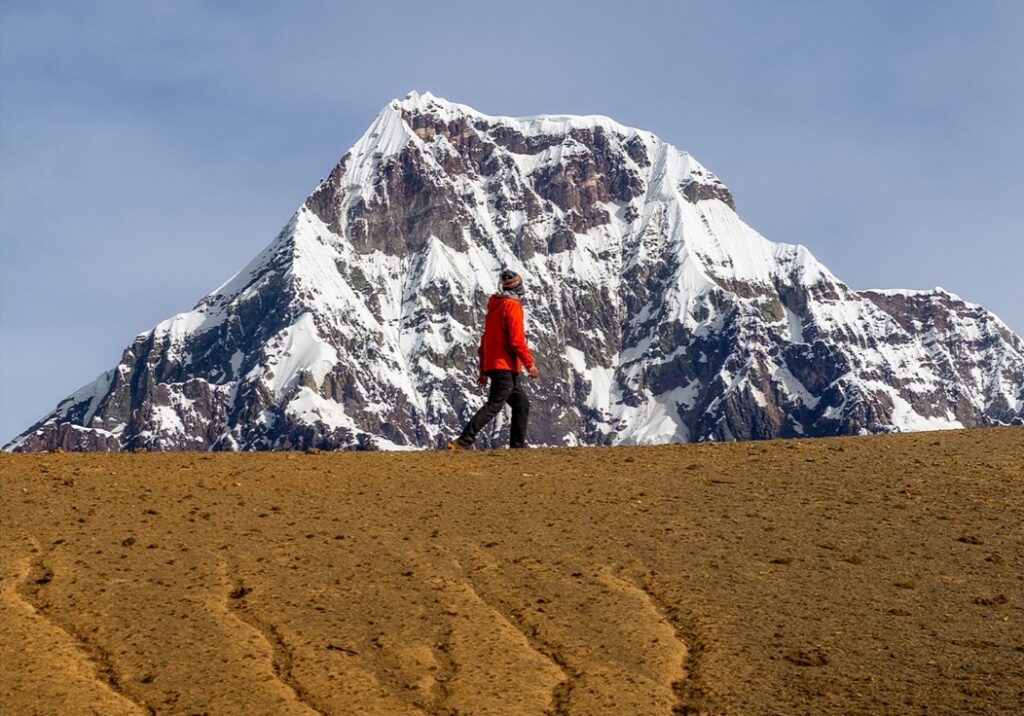
The trek circles Ausangate Mountain (6,384 m / 20,945 ft), the highest peak in the Cusco region and one of the most sacred mountains in Andean culture.
Throughout the journey you will experience:
- Massive glaciers and snow-covered peaks
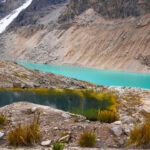
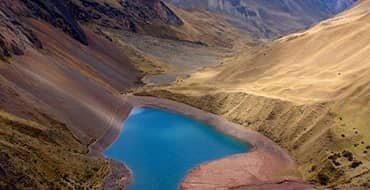
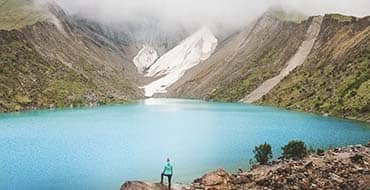
- Crystal-clear turquoise and emerald lakes
- Natural hot springs
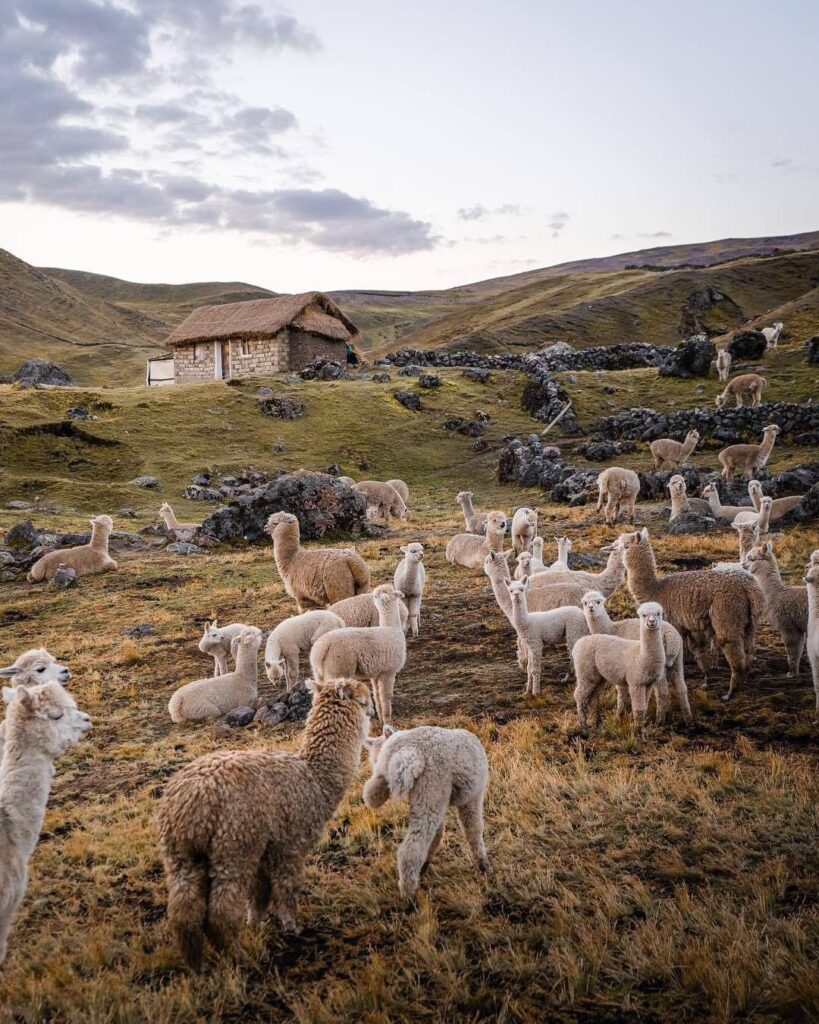
- Thousands of alpacas, llamas, and wild vicuñas
- Traditional Quechua communities
- Remote mountain landscapes with almost no tourists
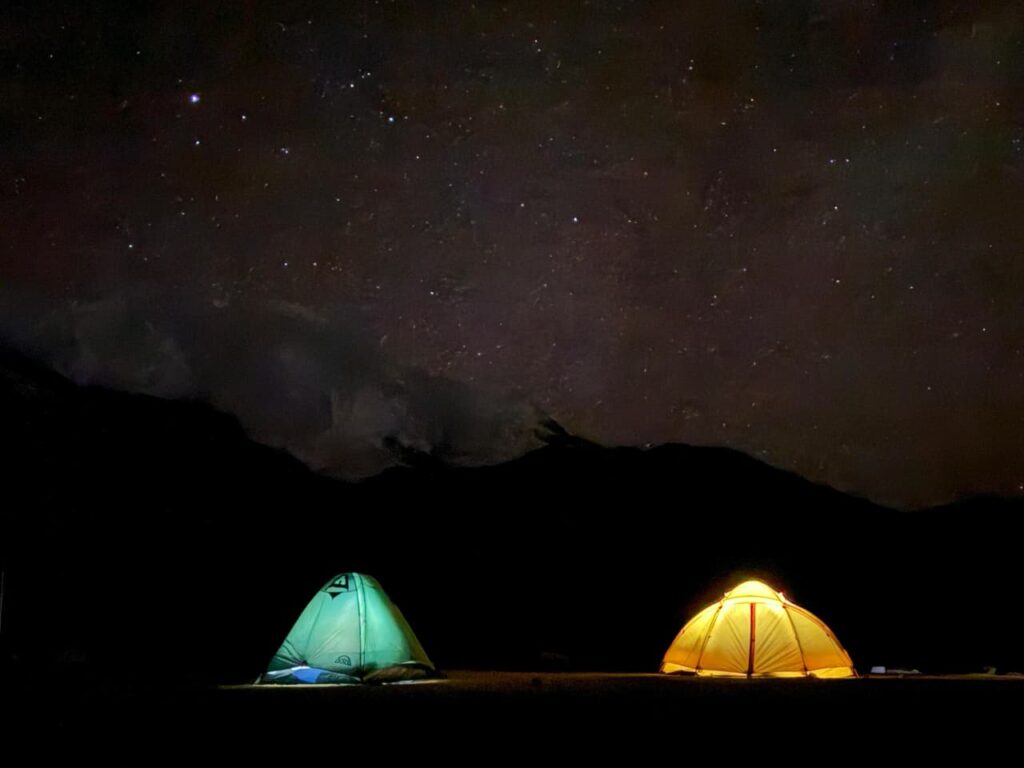
- Incredible night skies filled with stars
Unlike many popular trekking routes, Ausangate offers a true wilderness experience far from crowds and modern civilization.
Is the Ausangate Trek Difficult?
Yes, the Ausangate Trek is generally considered a moderate to challenging trek.
However, the challenge is not due to technical climbing or dangerous trails. Instead, it comes from three main factors:
1. High Altitude
Altitude is the biggest challenge.
Most of the trek takes place between 4,300 and 5,000 meters (14,100–16,400 ft) above sea level.
At these elevations, there is significantly less oxygen, making every step feel more demanding.
It is common to experience:
- Shortness of breath
- Slower walking pace
- Mild headaches
- Fatigue
- Reduced appetite
This is why proper acclimatization is essential.
2. Long Hiking Days
Depending on the itinerary, you will hike between 10 and 18 kilometers (6–11 miles) each day.
Expect to walk approximately:
- 5 to 8 hours daily
The pace is usually relaxed, allowing hikers to enjoy the scenery and adapt to the altitude.
3. Mountain Weather
Weather conditions can change rapidly.
During a single day you may experience:
- Bright sunshine
- Strong winds
- Rain
- Snow
- Freezing temperatures at night
Layered clothing is the best way to stay comfortable throughout the trek.
Can Beginners Do the Ausangate Trek?
Absolutely.
You do not need to be an experienced mountaineer to complete this trek.
Many travelers choose Ausangate as their first multi-day hiking adventure.
However, you should:
- Have a reasonable level of fitness
- Be comfortable walking several hours per day
- Spend a few days acclimatizing before the trek
With proper preparation, most healthy travelers can successfully complete the route.
Why Acclimatization Is So Important
One of the biggest mistakes visitors make is arriving in Cusco and starting the trek the next day.
It is highly recommended to spend at least 2 or 3 days in Cusco before beginning the Ausangate Trek.
During this time you can enjoy easier activities such as:
- Cusco City Tour
- Sacred Valley Tour
- Maras & Moray
- Humantay Lake
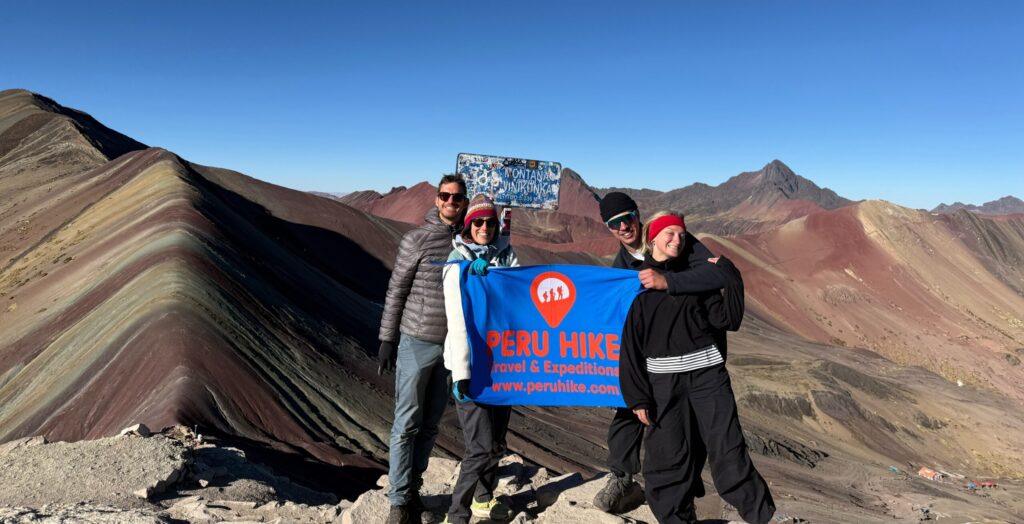
- Rainbow Mountain (if you already feel well acclimatized)
Giving your body time to adjust greatly reduces the risk of altitude sickness and makes the trek much more enjoyable.
Sleeping During the Ausangate Trek
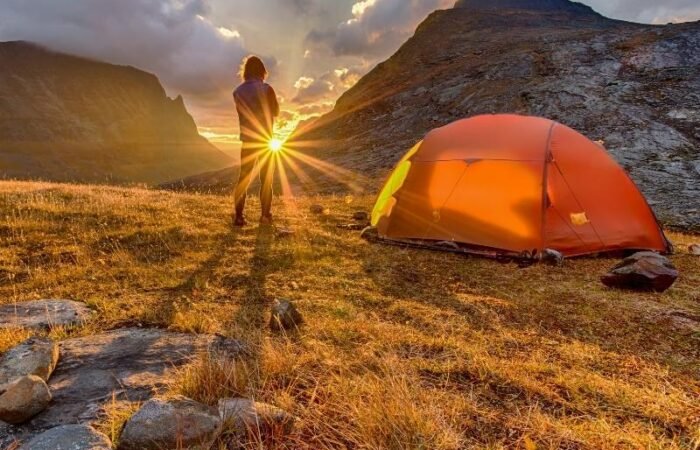
One of the most important things to know is that you will sleep in tents throughout the trek.
There are no hotels or lodges along most of the route.
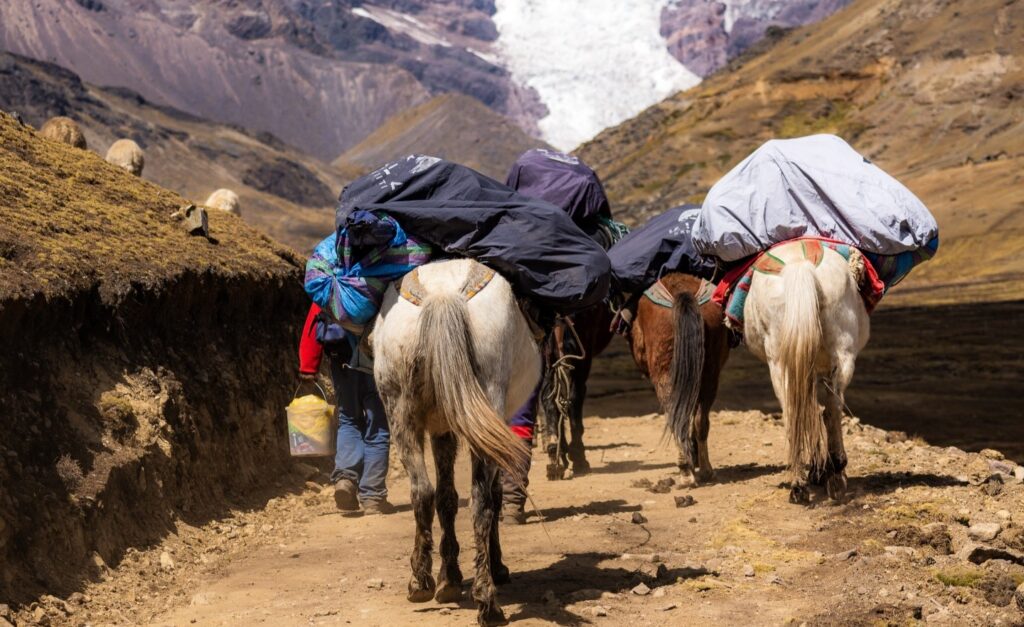
Each afternoon, the trekking team sets up a comfortable campsite that typically includes:
- Sleeping tents
- Dining tent
- Kitchen tent
- Portable toilet (depending on the tour operator)
Camping in the Andes is one of the highlights of the experience. At night, temperatures can drop below -10°C (14°F) during the dry season, so having a high-quality sleeping bag is essential.
Without city lights, the night sky becomes one of the clearest and most beautiful you will ever see.
Is There Phone Signal or Electricity?
For most of the trek, the answer is no.
This is one of the reasons why Ausangate feels so remote and authentic.
During almost the entire route there is:
- No mobile phone signal
- No internet connection
- No electricity
- No stores
- No ATMs
- No supermarkets
You are completely surrounded by nature, making it the perfect opportunity to disconnect from daily life and enjoy the mountains.
For charging cameras, phones, or other electronic devices, bringing a fully charged power bank is highly recommended.
The Only Places With Limited Services
There are only two villages where you may find limited phone service and basic facilities.
Upis
The small Andean community of Upis, located at approximately 4,250 m (13,943 ft), is the first village visited during the trek.
Here you can find:
- Traditional Quechua families
- Alpaca and llama farmers
- Small local shops
- Limited phone reception depending on the mobile provider
- Basic restrooms
- Natural hot springs nearby
Many trekking groups spend their first night at the nearby Upis Hot Springs Camp, where hikers can relax in the thermal pools while enjoying spectacular views of Ausangate Mountain.
Pacchanta
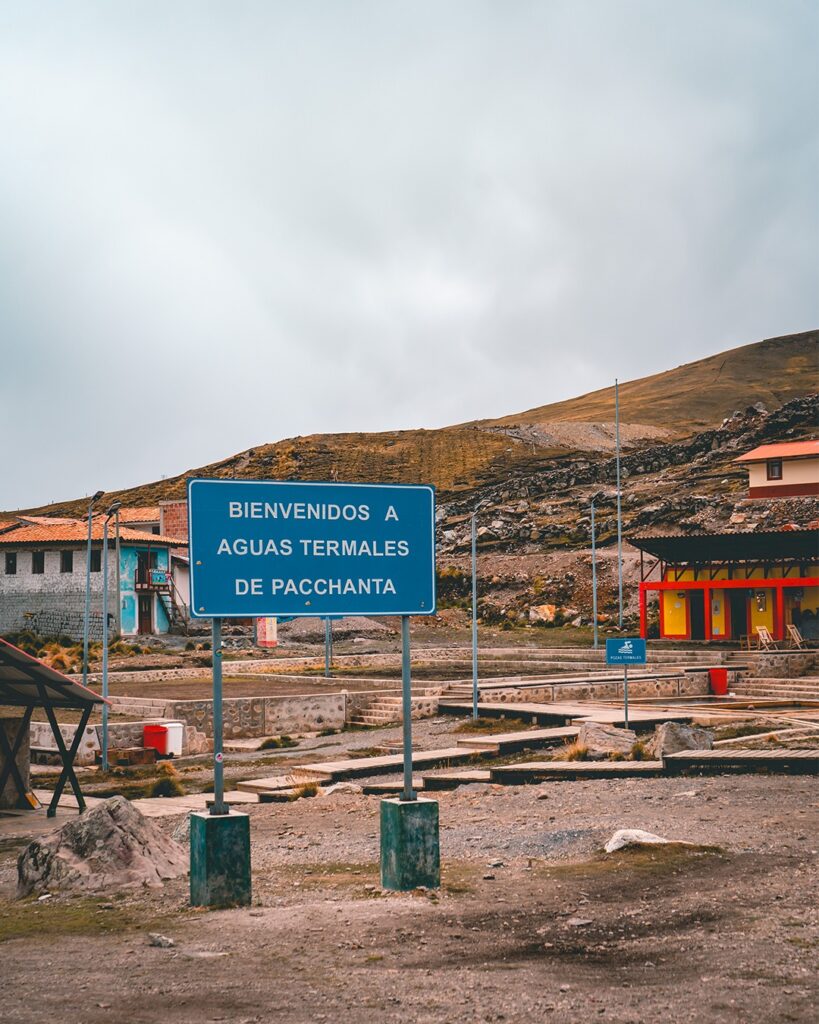
At the end of the trek, hikers arrive at Pacchanta, a beautiful Andean village located at approximately 4,300 m (14,108 ft).
Pacchanta is famous for its natural hot springs and stunning mountain scenery.
Here you will find:
- Small family-owned restaurants
- Basic grocery shops
- Rural accommodations
- Electricity
- Limited mobile phone signal
- Natural hot springs with breathtaking views of Ausangate
After several days of hiking, soaking in the hot springs is the perfect reward before returning to Cusco.
What Should You Pack?
Packing properly will make your adventure much more comfortable.
Clothing
- Waterproof jacket
- Warm insulated jacket
- Fleece layer
- Moisture-wicking shirts
- Hiking pants
- Waterproof pants
- Thermal base layers
- Warm hat
- Sun hat
- Gloves
- Neck gaiter or buff
- Several pairs of hiking socks
Footwear
- Waterproof hiking boots that have already been broken in
- Lightweight sandals or camp shoes
Never wear brand-new hiking boots on this trek.
Essential Equipment
- Daypack
- Reusable water bottle or hydration bladder
- Headlamp with extra batteries
- Trekking poles
- Sunglasses
- High SPF sunscreen
- Lip balm
- Quick-dry towel
- Personal toiletries
- Toilet paper
- Camera
- Power bank
- Personal medications
Tips to Prevent Altitude Sickness
The best way to enjoy the trek is to prepare your body.
Here are a few simple recommendations:
- Spend at least 2–3 days acclimatizing in Cusco.
- Walk slowly and maintain a steady pace.
- Stay well hydrated.
- Eat light but nutritious meals.
- Avoid alcohol before the trek.
- Sleep well every night.
- Listen carefully to your guide’s instructions.
- Never rush when hiking at high altitude.
Remember, this is not a race. Walking slowly is the key to reaching every mountain pass comfortably.
Best Time to Hike the Ausangate Trek
The dry season runs approximately from April to October.
These months usually offer:
- Sunny weather
- Clear mountain views
- Better trail conditions
- Lower chance of rain
The rainy season lasts from November to March. The trek is still possible, but trails can become muddy and weather conditions are less predictable.
Complete 5-Day Ausangate Trek Itinerary
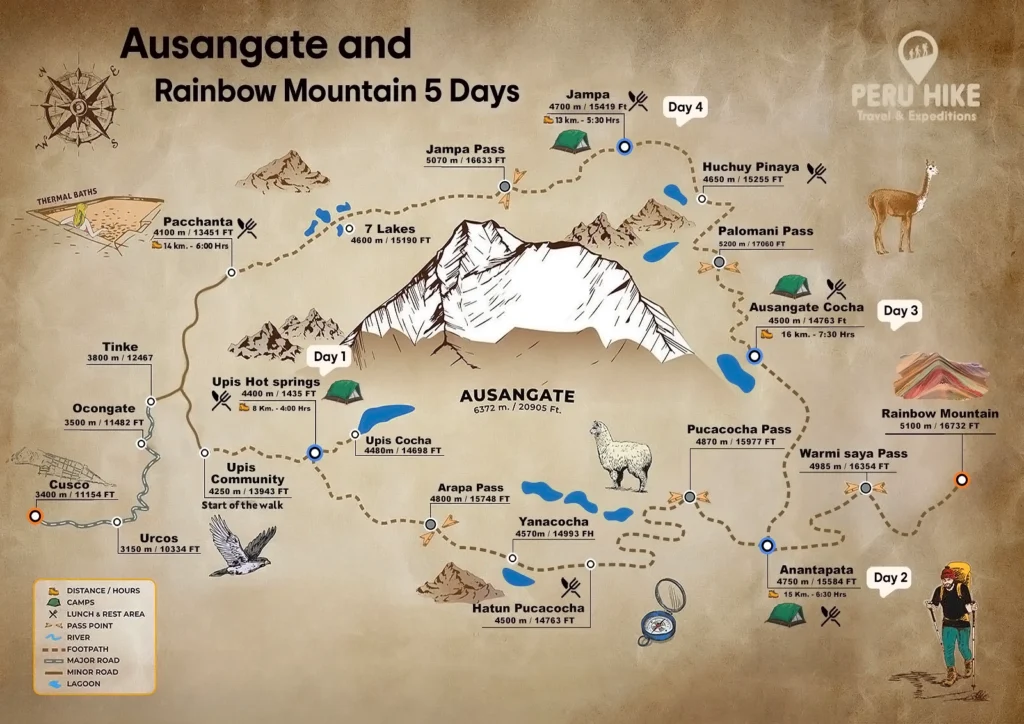
Day 1: Cusco – Upis Community – Upis Hot Springs Camp
Your adventure begins with an early morning hotel pickup in Cusco. After driving through the beautiful Andean countryside, you arrive at the trailhead and begin hiking toward the community of Upis.
The trail gradually climbs through wide valleys filled with alpacas and offers your first incredible views of Ausangate Mountain.
In the afternoon, you reach the campsite near the natural hot springs, where you can relax before dinner.
Hiking Time: 5–6 hours
Camp: Upis Hot Springs (4,400 m / 14,435 ft)
Day 2: Upis – Arapa Pass – Hatun Pucacocha Camp
Today’s hike takes you over Arapa Pass (4,800 m / 15,748 ft), where you’ll enjoy panoramic views of glaciers and colorful alpine lakes.
After descending through spectacular scenery, you arrive at the peaceful Hatun Pucacocha campsite.
Hiking Time: 7–8 hours
Camp: Hatun Pucacocha
Day 3: Hatun Pucacocha – Pucacocha Pass – Anantapata Camp
This is one of the most scenic days of the trek.
You hike past beautiful glacial lakes before climbing to Pucacocha Pass (4,870 m / 15,978 ft), offering some of the best panoramic views of the Ausangate range.
The day ends at the wide mountain plains of Anantapata.
Hiking Time: 7 hours
Camp: Anantapata
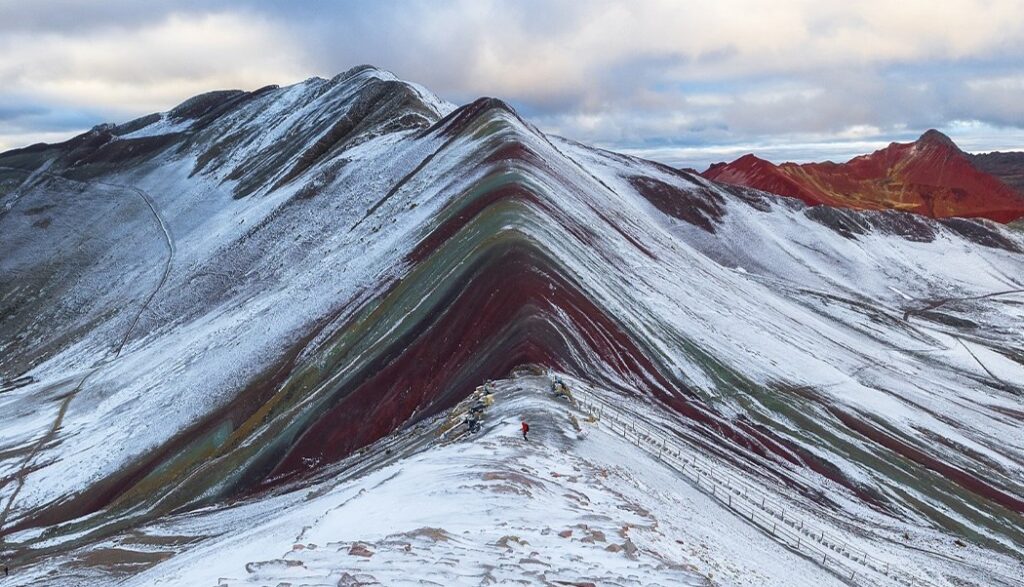
Day 4: Anantapata – Warmisaya Pass – Rainbow Mountain – Red Valley – Sorapata Camp
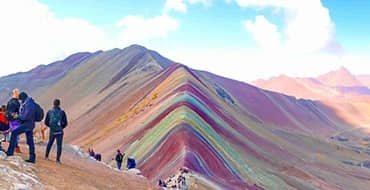
An early morning climb brings you to Warmisaya Pass (4,985 m / 16,355 ft) before descending toward the world-famous Rainbow Mountain (Vinicunca).
After enjoying the colorful landscapes, many itineraries continue through the spectacular Red Valley, one of the most unique geological formations in Peru.
Later, you continue to Sorapata Camp for your final night under the stars.
Hiking Time: Approximately 8 hours
Camp: Sorapata
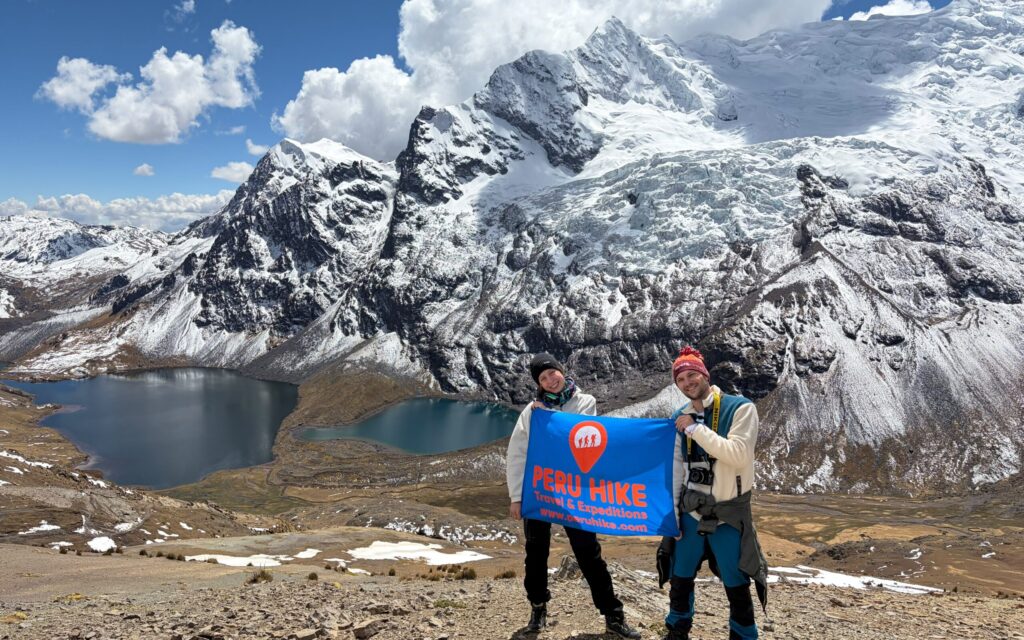
Day 5: Sorapata – Seven Lakes of Ausangate – Pacchanta – Cusco
The final day takes you through the breathtaking Seven Lakes of Ausangate, where brilliant shades of blue, turquoise, and emerald reflect the surrounding glaciers.
The trek finishes in the peaceful village of Pacchanta, where you can enjoy a relaxing soak in the natural hot springs before returning to Cusco.
This final day is the perfect ending to one of Peru’s most incredible trekking adventures.
Is the Ausangate Trek Worth It?
Without a doubt.
The Ausangate Trek is far more than just a hike—it is an unforgettable journey into one of the most remote and beautiful mountain landscapes in South America. You’ll spend five days surrounded by towering glaciers, pristine lakes, and traditional Andean culture, sleeping in tents beneath some of the clearest night skies on Earth.
Although the high altitude makes the trek physically demanding, anyone with reasonable fitness, proper acclimatization, and the right equipment can successfully complete it. If you’re looking for an authentic adventure far from the crowds, where nature remains untouched and every day brings extraordinary scenery, the Ausangate Trek is one of the best hiking experiences Peru has to offer.u.